

Everyone wants to know what they’re getting when they sign up to a new branding project. Most agencies summarise their process into three steps: discovery, design, delivery. I wanted to give a more detailed breakdown of your average brand project at Twilo. Some projects differ as requirements can be very varied, but here’s the rough pattern underneath most of our branding projects.
The Reason Why
Before you take that first step, there’s a big question you should be able to answer. Why now?
Maybe you’re a new business with a clean slate and you need an identity to launch with that will set you apart from your competition. Maybe your branding is tired and dated and you notice it every time you send out a proposal. Or perhaps you’ve grown or your company has changed direction and your brand no longer aligns with who you are and what you stand for. Maybe it’s that you’re positioned as the cheap option in the market when you’re actually the best. “I just wanted something fresh” is a perfectly valid reason too.
Finding The Golden Nugget
All of our projects, even the non-branding ones, start off with a discovery call. For all of our brand projects we prepare a discovery questionnaire. This usually takes around 30 minutes to complete, in person or over video call, with each question specifically curated to your brand and its specific needs. The purpose of this is to dig deep into your company and find that golden nugget, the thing that makes you different, the thing that your competitors can’t replicate.
This is often something that wouldn’t always surface naturally, something you take for granted that is actually quite unique to you. Maybe it’s a piece of incredible customer feedback, or something as simple as an interesting thing an employee said. It’s from this golden nugget that we can distil something that’s truly unique to you. Before we’ve even thought about the look and feel, it’s the idea that lives at the heart of what you do, and that’s the foundation that your brand can be built upon.
Market Research
Once we’ve got all the information we need from you, the next step is to get information on the market in which you operate. Identifying your key competitors and the space they occupy is crucial. Sectors often follow the same visual language, and it’s really important, especially in a world of growing AI-generated brands and content, that we create something truly unique and instantly recognisable as yours.
The main goal here is finding that balance of belonging and standing out. A finance company that looks like a gym brand loses trust and causes confusion. Equally, a company that looks like everyone else in their sector blends in and becomes invisible. The interesting space sits right between those two worlds, and this is what we’re aiming for.
This is also where we start to identify things that you can own as yours. Maybe it’s a certain colour, a font choice, or a consistent image treatment, something that no-one else seems to be doing that still sits right within the space.
Mood Boards Before Putting Pen to Paper
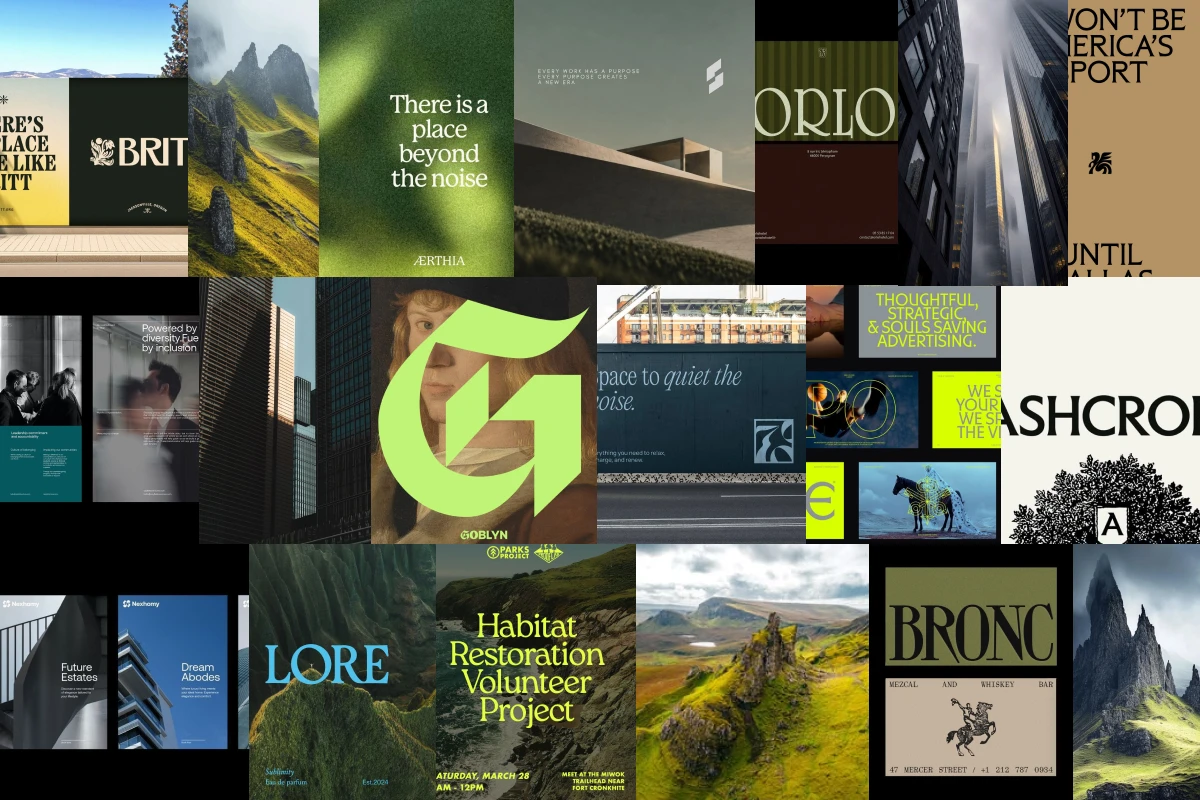
The first bit of actual design work we do in a branding project is to decide on an art direction for each of the routes we plan to create. The visual direction for each route is something that is influenced by the previous step, and very often something that is heavily guided from our initial discovery call. Everyone has preferences, and part of our discovery call is identifying yours.
These mood boards are made of images. Existing brand assets we like for a specific reason, photography, materials, packaging, all pointing in a loose visual direction. This process makes it easy for you to identify parts you like or don’t like, and helps guide us in the right direction.
Deliberately Different
We usually present two initial brand options. We find any more than this causes confusion and indecision; two routes allow us to spend time crafting more thoughtful pieces of work, whilst still giving you choice.
These routes are deliberately different. The first is often a safer route. Confident, presentable to a board, something that we think you might be expecting. The second option often pushes things further. Maybe more distinctive, a bit bolder, something designed to make you think.
Both routes have a core idea crafted into them, with a concept statement that summarises it in a single sentence. We would happily build out either route, as care and craft have gone into both in equal measure.
The Presentation
We then work both routes into a presentation and we meet again so that we can take you through our thinking. Each route is presented as a journey through the concept, where the idea came from, into the logo, the colours and typefaces, and even some applications to see it all working as one.
This is often the toughest point for most clients, as choosing one route means letting go of the other. Lifting your favourite parts from one route and trying to incorporate them into the other almost never works.
Development and Rollout
Once a route is chosen, we build it out fully.
This means seeing it in situ, creating all of the assets that were agreed in the original proposal. Whether that’s signage, business cards, email signatures, document templates etc. We continue developing the brand at this stage as we start to work out how the brand can be applied across different assets.
The last part of rollout is putting together a brand guidelines document that outlines how the brand should be used, and all of its key components. This is what helps keep the brand consistent when someone in your team goes to make a leaflet in six months’ time.
At the end of the rollout phase we provide you with all of the files you will need. That includes the files for all the assets we agreed in the proposal, as well as all of your logo files in different formats.
No Two Projects Are The Same
This is the general flow of a branding project at Twilo. Sometimes the order can shift. Some clients need help with naming or tone of voice before anything visual starts. Some clients have a huge bank of collateral that needs redesigning after the branding project is signed off.
What always remains the same are the core decisions. Learn about the business and find what makes it different (discovery), create something around that difference (design), and build it out until it works across everything (delivery).
If you’re currently at the ‘why now?’ stage and you can describe your reason, then maybe it’s time to take that first step. Get in touch today.